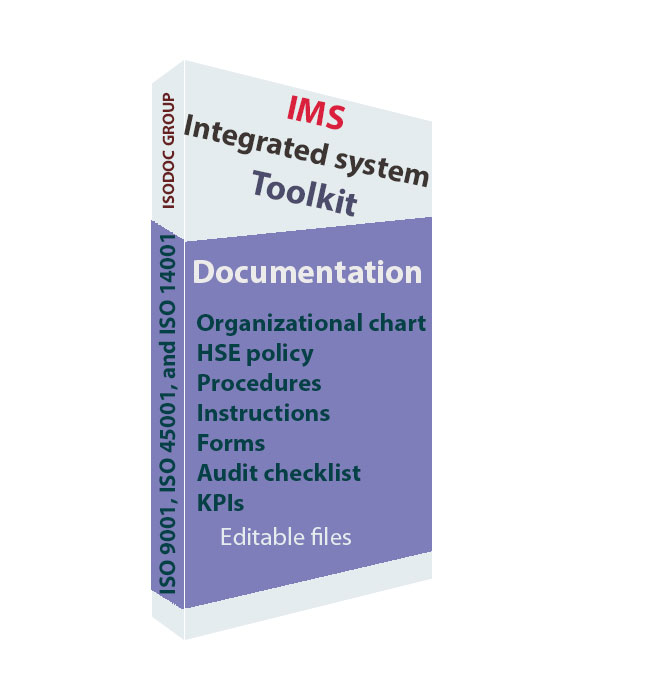
This toolkit has been developed in full compliance with the requirements of ISO 9001:2015, ISO 14001:2015, and ISO 45001:2018, and encompasses all documents required for the establishment and implementation of an Integrated Management System (IMS). The package includes the IMS Implementation Guide as an addendum, providing detailed instructions, practical examples, and deployment methodologies to facilitate the systematic implementation of IMS processes. All materials within the documentation package have been prepared in Microsoft Word and Microsoft Excel formats, ensuring they are fully editable and readily adaptable to organizational needs. The download link will be provided upon completion of the purchase process.
Number of procedures: 37
Number of instructions: 4
Number of processes: 25
Number of Forms: 117
Number of Matrix: 5
The IMS Implementation Guide:
Integrated Management System (IMS) Implementation Guide: The guide has been prepared in 204 pages in a structured format, encompassing all relevant standard clauses and detailed implementation steps. It includes 112 completed Integrated Management System forms derived from ISO 9001:2015, ISO 14001:2015, and ISO 45001:2018, serving as illustrative examples for a hypothetical organization. The guide provides a comprehensive reference to support the systematic establishment, implementation, and deployment of an IMS in accordance with international standards.
Integrated Management System (IMS) Implementation GuideFile Size: 758 KB
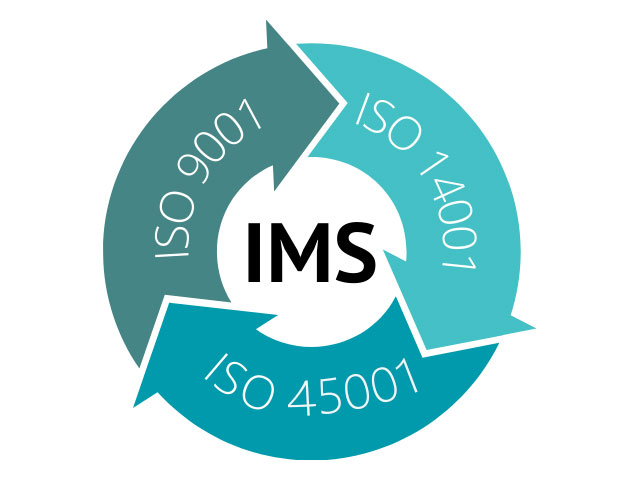
An Integrated Management System (IMS) toolkit is a comprehensive collection of resources, tools, templates, and guidance materials designed to help organizations implement and manage an Integrated Management System effectively. The toolkit is specifically created to support the integration of multiple management systems, such as ISO 9001 (Quality Management), ISO 14001 (Environmental Management), and ISO 45001 (Occupational Health and Safety Management), into a single, streamlined framework.
The IMS documentation structure, similar to other standards, encompasses key documents such as policies, identification of processes, procedures, forms, and templates, as well as inspection and audit checklists. In the following, we will introduce you to the key documentation of an IMS toolkit, which includes the following items and will be available to you in the form of Word and Excel files after purchase and download:
IMS Policy:
One of the most important documents of the integrated management system is the IMS policy, which is designed in such a way that it covers the requirements of the three standards and is able to meet the quality, safety, and environmental goals of the organization. In this package, you will find an example of integrated quality, environmental, and safety policies
Templates and Forms:
Another key component of IMS documentation is the use of templates and forms for collecting information, performance evaluation, internal auditing, analyzing data, reporting performance, and subsequently maintaining records of the integrated management system’s implementation.
An Integrated Management System (IMS) toolkit is a comprehensive collection of resources, tools, templates, and guidance
Download the free IMS form template PDF
Provided below is an example of a continuous improvement form available in both Word and PDF formats, pertaining to integrated management systems.
Another crucial document within the IMS documentation package is the set of procedures. These procedures establish structured and coherent frameworks that encompass standard requirements, organizational needs, and legal and regulatory obligations in the areas of quality, safety, and the environment. They serve as a comprehensive guide for implementing the integrated management system.
An Integrated Management System (IMS) toolkit is a comprehensive collection of
The procedures outline how processes should be executed and provide specific forms and templates for recording reports and maintaining records within the integrated management system.
Download the free IMS procedure template PDF
Provided below is the legal requirements procedure, available in PDF format, as an example of IMS documentation related to integrated management systems.
In fact, the process identification within the Integrated Management System (IMS) defines its overall structure, specifying the inputs, outputs, and activities associated with each process. Additionally, within the processes, performance indicators and acceptance criteria are determined, and the risks of not achieving the desired performance are assessed.
Reviewing the Internal Requirements of the Organization
Analyzing the Requirements and Demands of Stakeholders Related to Communications Assessing Linguistic Diversity, Cultural Differences, and Other Relevant Factors. Determining and preparing the internal and external communication matrix by considering the following factors:
a) What will be communicated.
b) communication time.
c) Who should be contacted:
1) Internal among different levels and tasks of the organization.
2) among contractors and visitors to the workplace.
3) among other interested parties.
d) How to communicate
Communication procedure
internal communication matrix
external communication matrix
processes (organization unites)
external interested parties (Customers – suppliers- contractors- Government institutions)
Is the definition and development of IMS processes necessary?
The ISO 9001, ISO 14001, and ISO 45001 standards clearly emphasize, in clause 4.4, the establishment, implementation, maintenance, and continual improvement of management systems related to quality, occupational health and safety, and environmental management, including their associated processes. However, ISO 9001, in the same clause, specifically highlights the importance of maintaining documented information to support the operation of processes and to ensure that they are executed in accordance with the established plan.
ISO 9001 requirements for processes
4.4 Quality management system and its processes 4.4.1 The organization shall establish, implement, maintain, and continually improve a quality management system, including the processes needed and their interactions, in accordance with the requirements of this International Standard.
The organization shall determine the processes needed for the quality management system and their application throughout the organization, and shall: a) determine the inputs required and the outputs expected from these processes; b) determine the sequence and interaction of these processes; c) determine and apply the criteria and methods (including monitoring, measurements, and related performance indicators) needed to ensure the effective operation and control of these processes; d) determine the resources needed for these processes and ensure their availability; e) assign the responsibilities and authorities for these processes; f) address the risks and opportunities as determined in accordance with the requirements of 6.1; g) evaluate these processes and implement any changes needed to ensure that these processes achieve their intended results; h) improve the processes and the quality management system.
4.4.2 To the extent necessary, the organization shall:
a) maintain documented information to support the operation of its processes;
b) retain documented information to have confidence that the processes are being carried out as planned.
ISO 14001 requirements for processes
4.4 Environmental Management System
To achieve the intended outcomes, including enhancing its environmental performance, the organization shall establish, implement, maintain, and continually improve an environmental management system, including the processes needed and their interactions, in accordance with the requirements of this
International Standard.
The organization shall consider the knowledge gained in 4.1 and 4.2 when establishing and maintaining
The environmental management system.
ISO 45001 requirements for processes
4.4OH&S management system
The organization shall establish, implement, maintain, and continually improve an OH&S management system, including the processes needed and their interactions, in accordance with the requirements of
this document.
IMS internal audit checklist
The IMS audit checklist is a questionnaire-based document that encompasses the requirements of the ISO 9001, ISO 14001, and ISO 45001 standards. During the internal audit process, the audit team assesses the clauses of the standards related to the integrated management system by questioning those responsible for the organization’s processes. The results are then communicated to process owners by the lead auditor in the form of conformity, non-conformity, or opportunities for improvement.
A critical aspect of the audit checklist and its implementation is the ability to understand the standard clauses and relate them effectively to the organization’s processes and operations.
What are the IMS documentation requirements?
In general, the requirements of IMS documentation encompass those of the following three standards: Quality Management System (ISO 9001), Environmental Management System (ISO 14001), and Occupational Health and Safety Management System (ISO 45001). The implementation of all or part of these requirements depends on the type of organization, its products and services, the nature of its operational processes, and the demands of stakeholders, which vary from one organization to another.
The Integrated Management System (IMS) toolkit is a comprehensive collection of resources, tools, and templates
Integrated Management System (IMS) toolkit
IMS Documentation
The Integrated Management System (IMS) Toolkit contains all the mandatory and optional documents required for implementing an Integrated Management System, provided in Word format. The PDF list of IMS toolkit documents is available for download below.
2 reviews for Integrated Management System (IMS) toolkit
Rated 5 out of 5
Henry walker –
I am thoroughly impressed with the quality and effectiveness of the IMS toolkit acquired.
Rated 5 out of 5
Asif Muhammad –
Thank you for this toolklt,
The IMS package is very useful, the processes are fully comprehensively described and procedures are effectively available.



Henry walker –
I am thoroughly impressed with the quality and effectiveness of the IMS toolkit acquired.
Asif Muhammad –
Thank you for this toolklt,
The IMS package is very useful, the processes are fully comprehensively described and procedures are effectively available.